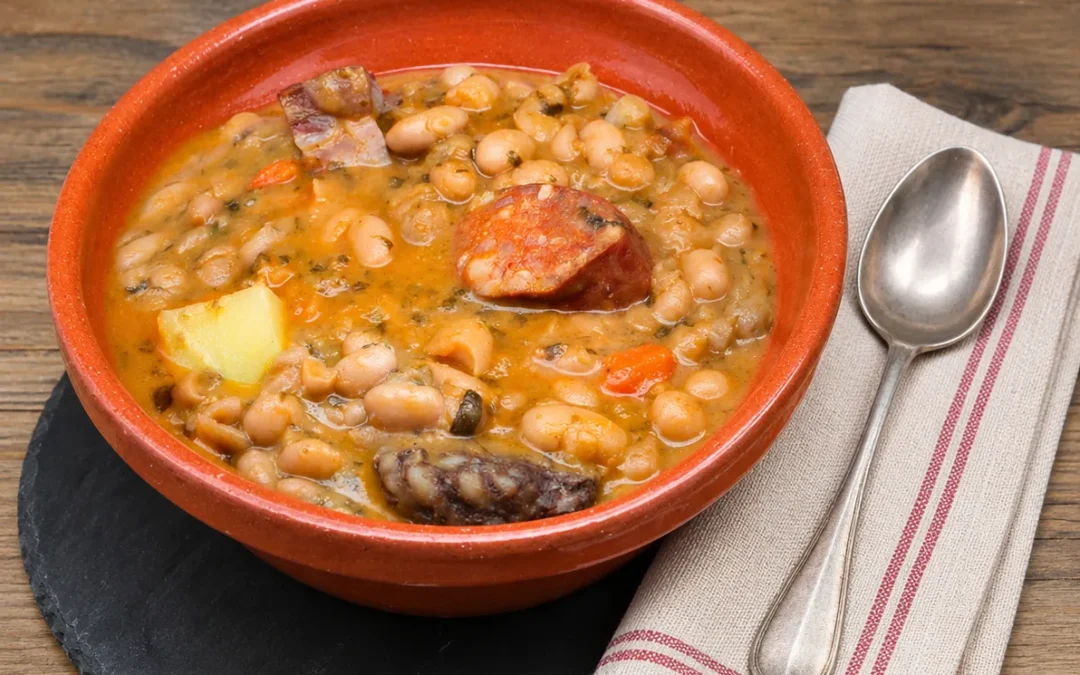
When the cold arrives in Cantabria, few things feel as comforting as a deep bowl of cocido montañés. White beans, greens and pork come together in a slow-cooked stew made for lingering over. It is one of the region’s best-loved dishes and a delicious introduction to Cantabrian cooking during a stay in Reinosa and Campoo.
What is cocido montañés?
Cocido montañés is made with white beans and greens, accompanied by compango: pork and cured meats such as chorizo, morcilla, ribs and bacon or pork belly. The selection and quantities vary from home to home and across the region. Some versions also include potato, turnip or other products from the traditional pig slaughter.
The dish belongs to the cooking traditions of inland Cantabria, drawing on foods that helped people through the colder months. Today you will find it on menus throughout the region, though every kitchen has its own version. If you hope to try it on a day trip, ask whether it is available before booking.
Cocido montañés and cocido lebaniego: two different stews
Both are Cantabrian stews, but their foundations differ. Cocido montañés is made with white beans and greens; cocido lebaniego centres on chickpeas with meat and sausages. Knowing the difference helps when reading a menu—and gives you a good reason to try both.
A traditional cocido montañés recipe
This home-style version follows the traditional combination described by Spain’s national tourist office and Selaya town council. There is no single recipe: you can vary the meats or add potato. The quantities below are a guide for four generous servings.
Ingredients
- 400 g dried white beans.
- One medium cabbage or bunch of collard greens, approximately 700 g–1 kg before trimming.
- 300 g marinated pork ribs.
- 150–200 g pork belly or bacon.
- One cooking chorizo and one cooking morcilla (Spanish blood sausage).
- One onion, two garlic cloves, one teaspoon of sweet paprika, olive oil and salt.
- One or two medium potatoes, optional.
Method
- The night before. Soak the beans overnight in plenty of water. Drain the next day.
- Start cooking. Put the beans in a large pot with enough water to cover them generously. Add the ribs, pork belly and chorizo. Bring to the boil, skim off any foam and reduce to a gentle simmer. Add water as needed.
- Prepare the greens. Wash the leaves, remove the toughest parts and chop. When the beans and meats begin to soften, add the greens and, if using, the peeled and chopped potatoes.
- Make the sofrito. Gently cook the chopped onion and garlic in a little oil. Take the pan off the heat before adding the paprika so it does not burn, then add the mixture to the pot.
- Simmer gently. Add the morcilla towards the end and cook gently until the beans, greens and meats are tender and the sausage is thoroughly cooked. This may take around 1½–2½ hours in total, depending on the beans and meat; check for tenderness. Taste the broth and adjust the salt at the end.
- Serve. Let the stew rest for a few minutes, then serve the beans and greens with the meats cut into pieces. You can also serve the meats separately on a platter.
If making the stew ahead, cool it and keep it refrigerated. Reheat each portion thoroughly before serving. Adjust the cooking time and amount of broth to suit your preferred texture.
A taste of Cantabria from Reinosa
Reinosa makes a convenient base for several days in Campoo. After visiting its villages, the source of the Ebro or the reservoir, return to town for a stroll, some shopping and a choice of places to eat. You can also pick up ingredients and prepare a relaxed dinner in the kitchen-dining room at El Reino y la Osa.
Where to eat in Reinosa · Food in Campoo · Olla ferroviaria and San Sebastián · Explore the house · Travel journal
Sources and variations
External links open in a new tab.