REINOSA · CAMPOO · HISTORY
Campoo: the story of a land between mountains
At Cantabria’s southern edge, the mountains open into a region that has connected the Iberian interior with the coast for centuries. Campoo occupies the passage between the upper Ebro valleys, the plateau and the routes down to the sea through the Besaya basin. Its history can be traced not only through its roads, but through the communities that settled beside them, the powers that sought to govern them and the activities that transformed life in the valley.
The terrain shaped what was possible here. High pastures favoured livestock farming; waterways powered mills and ironworks; and transport routes made Reinosa a meeting place for merchants, travellers and carters. Each era used those conditions differently. The result is a region where traces of the Iron Age, Roman occupation, medieval lordships and the great industrial changes of the last two centuries lie close together.
Early inhabitants and the hillfort of Las Rabas
Human occupation goes back to prehistory. Over time, communities developed permanent settlements and ways of using the land that archaeology can trace more precisely from the Iron Age. One of the most important sites is the hillfort of Las Rabas, near Celada Marlantes, a Cantabrian settlement in a strategic position overlooking the surrounding area. Finds of pottery, weapons, tools and ornaments tell of daily life and contacts with other regions.
Rome in Campoo and the debate over Julióbriga
Between 29 and 19 BC, Rome’s campaigns against the Cantabri and Astures brought this region under imperial rule. Conquest changed power relations, administration and communications. Campoo became part of a network linking the plateau to the coast, and the Roman world left a particularly visible mark here.
Pliny the Elder mentioned Iuliobriga in his Natural History when describing Cantabrian territory and the Ebro’s source. For a long time, his words were linked to the Roman ruins at Retortillo, near Reinosa, where excavated streets and houses suggest a life very different from that of the old hillforts. That identification, common in historical writing and heritage signage, is now being reconsidered: research published in the Bulletin of the Royal Academy of History has proposed that the city named in ancient sources may instead correspond to Camesa-Rebolledo in Valdeolea. The proposal has opened an important archaeological debate. Both sites and the area’s epigraphic evidence form part of research into Roman Campoo.
Explore the debate over Julióbriga and Retortillo →
Transport routes help explain the importance of these settlements. The Peña Cutral corridor, where remains of a Roman road survive, formed part of the links between the interior and the northern valleys. People, goods and news travelled along these routes. Rural farms and settlements grew around them, and their continuity and change reveal patterns of settlement over several centuries.
The Middle Ages: Reinosa, monasteries and lordships
As Roman urban structures declined and the early Middle Ages began, the region adopted other forms of organisation. Villages, churches and small rural settlements gained importance. The area gradually became part of the political structures of the northern Christian kingdoms and later Castile, while the networks of ownership and dependence recorded in medieval documents took shape. Reinosa appears in a document from the year 1000 as Renosa. Its position beside the river and at a meeting of routes would eventually encourage its commercial and administrative growth.
Monasteries and religious centres played an essential part in that organisation. At Cervatos, the collegiate church of San Pedro preserves one of Cantabria’s great Romanesque ensembles. Its doorway, apse and extraordinary carved corbels show the artistic richness of a region engaged with medieval Europe’s cultural currents. Churches such as those at Bolmir and Retortillo complete a journey through the architecture of this period.
Discover the collegiate church of Cervatos →
At the same time, noble families built fortresses and towers to defend property and assert authority. Argüeso Castle is the most visible example. Its towers date from the thirteenth and fourteenth centuries; the connecting building and wall are fifteenth-century. The complex was a centre of power for the Vega-Mendoza family, with a history intertwined with Leonor de la Vega and the Mendozas. Other towers, such as Proaño’s, recall the reach of noble networks across villages, pastures and roads.
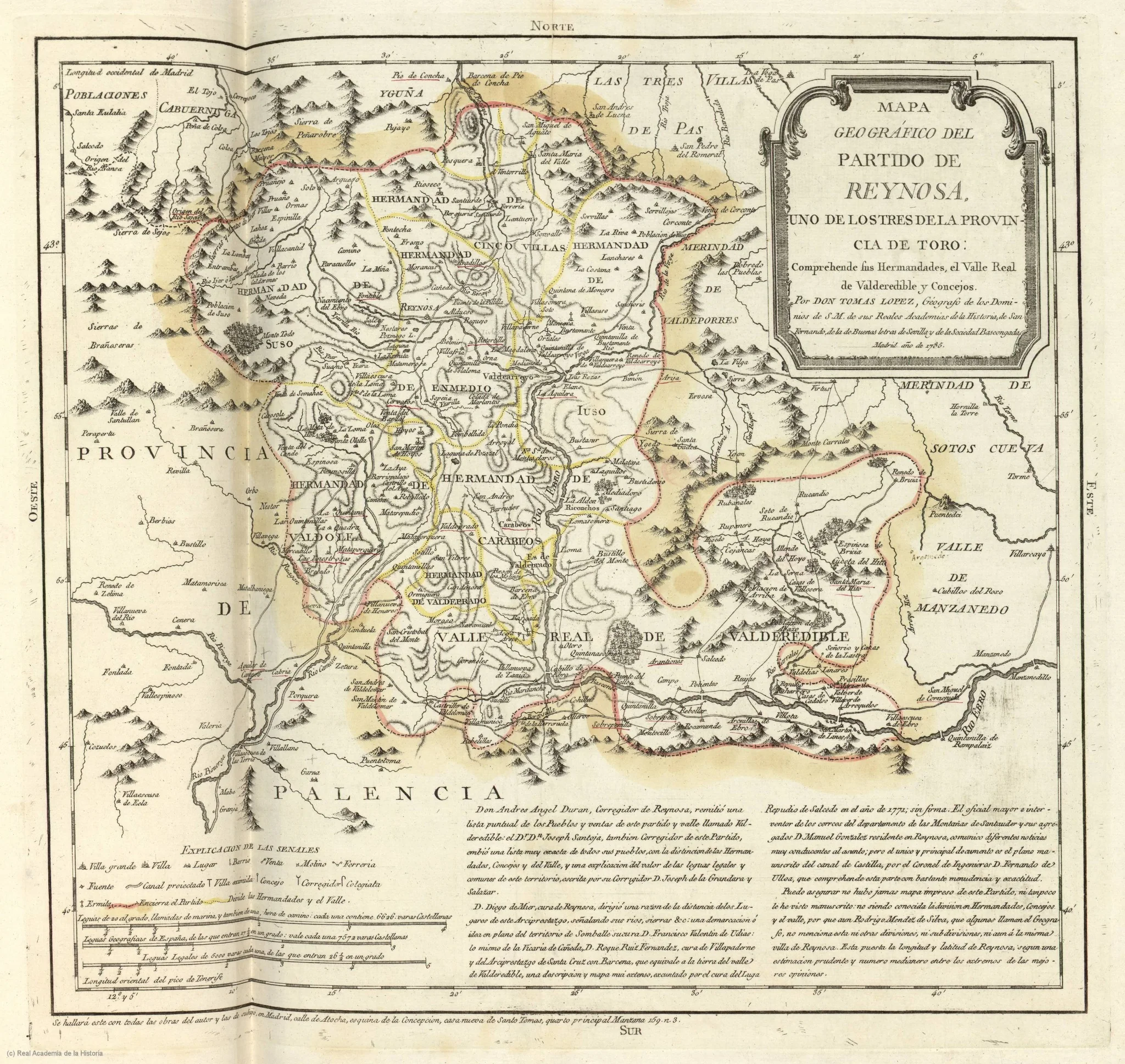
Daily life was also shaped by local councils. Neighbours regulated the use of meadows and woodland, organised common resources and dealt collectively with matters involving livestock, roads and community life. During the fourteenth and fifteenth centuries, many councils joined the seven brotherhoods of the Merindad de Campoo: Campoo de Suso, Campoo de Yuso, Campoo de Enmedio, Cinco Villas, Los Carabeos, Valdeolea and Valdeprado. Reinosa headed the organisation and hosted its General Council, where the brotherhoods were represented. The region’s map took shape through a combination of local institutions, royal authority and noble jurisdictions.
Reinosa between Castile and Cantabria
That administrative history explains details that may surprise today’s visitor. Under the Old Regime, the district of Reinosa was linked to the former province of Toro within Castilian fiscal and judicial divisions. In the early nineteenth century it went through further reorganisations, including periods under Palencia, before its definitive incorporation into the province of Santander in 1833. Campoo’s position between mountains and plateau was reflected in the institutions that governed it.
For generations, livestock farming was a foundation of the rural economy. Common pastures, communal herding and seasonal movements shaped the calendar and use of the land. Trades involving wood, iron and transport grew around them. Mills and ironworks operated on the waterways; farmers, livestock dealers and muleteers met on the roads. Reinosa grew as a market town for a wide area, with livestock fairs and commerce serving nearby villages and travellers passing through the valley.
The Camino Real and the flour trade
A major boost to communications came in the eighteenth century. The Camino Real between Reinosa and Santander, promoted under Ferdinand VI and opened to traffic in the middle of the century, made it easier for Castilian goods to reach the port. The bridge over the Ebro and improvements to the route through town accompanied this transformation. Carts, warehouses, smithies, inns and merchants filled the town. Grain trading, shops and fairs began to leave their mark on its architecture and streets.
Wheat became particularly important among the goods crossing Campoo. Grain from Castile could be stored and milled into flour before continuing to Santander, where some was shipped elsewhere, including to Spain’s overseas possessions. River power supported mills and later flour factories. The trade employed millers, carters, merchants and many associated workers, linking Campoo’s economy to far-reaching commercial networks.
The Peninsular War in Campoo
The Peninsular War violently interrupted that prosperity. In June 1808 French troops occupied Reinosa and advanced along the approaches to the Besaya. At Lantueno on 21 June, General Merle’s forces defeated the defenders led by Juan Manuel Velarde. Occupations, forced supplies, requisitions and debts left lasting consequences for residents and municipal finances. Campoo experienced directly the cost of a war fought along major transport routes.
Flour mills and nineteenth-century industry
In the following decades, grain trading and processing recovered. The period from 1830 to 1860 was especially favourable for flour milling. Historical material collected by Cantabria’s College of Architects records sixteen flour factories in the judicial district of Reinosa in 1845, out of twenty-six in the then province of Santander, accounting for nearly sixty per cent of provincial production. The figure covers the whole judicial district and shows the regional scale of the boom, with Reinosa as a storage and trading centre. Local records also recall mills and factories such as San Esteban, La Central and La Húngara as part of the town’s working landscape.
Read the story of La Húngara and Campoo’s flour mills →
As the nineteenth century progressed, the economy became more varied. Milling adopted machinery and new processes. Food industries making cheese, butter and chocolate appeared in and around Reinosa. A cheese factory is documented in the 1840s; in 1880 Claude Napoléon Boffard established La Reinosana, important in the development of industrial cheesemaking. Glassmaking, established in 1871, opened another chapter in the town’s industrial history. Ironworks and nearby mineral extraction added to a production base far more varied than the later image of a single large steelworks might suggest.
The railway reaches Reinosa
The railway brought decisive change. The line between Alar del Rey and Santander was completed in 1866, changing journey times, costs and transport. Carts gradually lost their role in moving goods, and some businesses linked to the old Camino Real suffered. The station attracted new services and strengthened other commercial and industrial opportunities. Reinosa had to adapt as economic activity shifted from road traffic towards different services and forms of production.
At the end of the nineteenth century, the town still combined rural features with growing commercial and industrial activity. Its market remained closely tied to Campoo’s livestock farmers, while factories, warehouses and new transport changed work and the appearance of the streets. This society also produced cultural initiatives and figures who gave Reinosa intellectual and artistic reach; their stories belong to a chapter of their own.
La Naval and Reinosa’s industrial transformation
The great industrial transformation of the twentieth century began with the Sociedad Española de Construcción Naval, established in Reinosa in 1918 and brought into operation in 1919. Known as La Naval, the works produced forgings, castings and special steels, attracting workers from the region and beyond. By 1923 it employed 1,324 people; neighbourhoods, services and daily life organised around factory shifts grew up around it. Reinosa acquired an industrial character that would shape generations.
The Ebro reservoir: a valley transformed
Industrial growth coincided with another intervention of enormous consequence. Work on the Ebro reservoir began in 1921, intended to regulate the river and meet the water needs of a vast basin. Construction lasted decades, spanned the Civil War and ended in 1945. Filling began in 1947 and the official inauguration followed in 1952. The project affected Campoo and northern Burgos, flooding farmland and settlements and forcing many families to leave their homes. Villages lost beneath the water included Medianedo, La Magdalena, Quintanilla and Quintanilla de Bustamante.
Construction also had a painful political and social dimension. The University of Cantabria documents the use of political prisoners on the project during Franco’s dictatorship, as well as unfulfilled promises of compensation to those affected. The reservoir changed roads, distances and relationships between villages. The broad expanse of water that now seems inseparable from Campoo’s landscape was, for those who knew it before, a radical transformation of their land and way of life.
Discover the Ebro reservoir’s history and memories →
Industrial crisis and the 1987 protests
Meanwhile, La Naval remained Reinosa’s main economic engine. The factory went through expansion, changes of ownership and production adjustments. During the second half of the twentieth century, industrial crises and restructuring threatened an economy on which many families depended. In 1981, after separation from Astilleros Españoles, the works became Forjas y Aceros de Reinosa. Job losses and adjustment plans sparked deep social conflict.
In 1987, protests against industrial restructuring put Reinosa in the national spotlight. The demonstrations, confrontations and their aftermath revealed the human scale of the crisis. For the region, far more than a workforce was at stake: it was the future of a town that had grown around the factory and needed new ways to sustain its economy and population.
Campoo’s memory today
Campoo’s recent history bears the marks of all these changes. Livestock farming still shapes many villages and meadows; roads and railway keep Castile and Cantabria connected; the reservoir recalls a transformation that affected generations; and Reinosa’s buildings and memories preserve the commerce and industry that made it the regional centre. Medieval towers, Romanesque churches, ancient sites and factories belong to different eras but share the same land. To travel through Campoo is to encounter that history in places still woven into everyday life.
Meet the people of Reinosa and Campoo →
If you’d like time to get to know Campoo, discover El Reino y la Osa, our house in Reinosa, and explore our guides to help plan your visit.
Sources and further reading
Links to other websites open in a new tab.
- Ayuntamiento de Reinosa, «Historia de Reinosa»
- Ayuntamiento de Valdeolea, «Territorio»
- Colegio Oficial de Arquitectos de Cantabria, «Reinosa. Historia de un camino»
- Encarnación-Niceas Martínez Ruiz, «Reinosa hace 100 años», Cuadernos de Campoo, n.º 1
- Pedro Casado Cimiano, «Las queserías de Reinosa», Cuadernos de Campoo, n.º 15
- Castillo de Argüeso, «Historia»
- Confederación Hidrográfica del Ebro, nota histórica sobre el embalse, 18 de diciembre de 2025
- Universidad de Cantabria, «El pantano del Ebro: un amargo espejo de agua dulce. El precio»
- Ayuntamiento de Campoo de Yuso, «Embalse del Ebro»
- Reinosa Forgings & Castings, «Quiénes somos», cronología histórica
- Ayuntamiento de Campoo de Enmedio, «Historia», Castro de Las Rabas
- Real Academia de la Historia, Pedro Ángel Fernández Vega, Lino Mantecón Callejo y Rafael Bolado del Castillo, «Julióbriga: la hipótesis de Camesa-Rebolledo», Boletín de la Real Academia de la Historia, tomo CCXXII, cuaderno III (2025), pp. 291-332
- «Campoo en la época de la Guerra de la Independencia», Cuadernos de Campoo, n.º 7
- Red de Patrimonio Industrial de Cantabria, «La Naval»