A small region with a remarkable legacy
Visitors to Reinosa and Campoo often remember the landscape first: its changing light, the nearness of the mountains, the sense of a place between regions. But there is more to this land than its scenery. Over time it has produced a wide variety of figures: soldiers, lawyers, politicians, painters, scientists, doctors, scholars, businesspeople and public figures.
Taken together, their stories reveal a region with a presence in many areas of history. Some achieved extraordinary prominence; others led quieter lives. Each helps us understand the place a little better.
From Julióbriga to New Spain
Our story begins in the Roman world. Quintus Porcius Vetustinus, a native of Iuliobriga—the Roman town near present-day Reinosa—was a soldier and priest in Roman Hispania. He served as prefect of an auxiliary unit in Lower Germania and was later elected flamen of Hispania Citerior at Tarraco. His life shows how this area was already part of far-reaching political, military and religious structures almost two thousand years ago.
Centuries later, that outward reach reappeared in the life of Juan Francisco de Güemes y Horcasitas, born in Reinosa in 1681. A career soldier, he became governor of Cuba and later viceroy of New Spain, holding positions of considerable responsibility in the imperial administration.
His time in Cuba was shaped by war with England and the need to strengthen defences. He improved fortifications, organised militias and had to respond to the English landing at Guantánamo in 1741.
Later, as viceroy of New Spain, he dealt with mining, taxation, defence, ecclesiastical reorganisation and the colonisation of Nuevo Santander. Several settlements received names from his home region, including Reinosa, Burgos, Camargo, Revilla and Santillana—a reminder of how far a place’s memory can travel.
Soldiers and jurists of Reinosa and Campoo
Military service also figures prominently in this history. Manuel García del Barrio, from Argüeso, led a life that reads like a novel: he served in the Americas, fought in Darién, equipped ships at his own expense to pursue privateers and smugglers, and captured British vessels.
During the Peninsular War, he organised troops and linked local governing juntas, was mistaken for a French spy, suffered harsh treatment and was sentenced to death before being pardoned. He later returned to fighting and continued to serve.
In another era, Darío Díez Vicario, born in Reinosa in 1856, pursued a military career that took him from the Carlist War to Cuba and finally North Africa. In Cuba he was promoted for wartime service and received several Red Crosses of Military Merit. In 1909, by then a brigadier general, he was assigned to the Rif operations and died of wounds received near Tetouan; he was promoted to major general that same day.
Yet one field in which Reinosa and its surroundings left a particularly visible mark was politics, justice and the institutions of the state.
A central figure is Fernando Calderón de la Barca y Collantes, the first Marquess of Reinosa, born in 1811. A highly regarded jurist, several times a minister, president of the Supreme Court, senator, deputy, councillor of state and member of the Royal Academy of Moral and Political Sciences, his life reflects a significant part of nineteenth-century Spain’s political and legal history.
Episodes from his life illuminate that career. While serving as a judge in Ribadeo, he gave up two thirds of his salary to meet the court’s expenses and devoted the remaining third to the costs of the Carlist War. He actively helped organise the National Militia and took on public-order responsibilities in difficult times. Later, he helped reform the justice system, codify the law and establish the Central Register of Defendants and Convicted Persons in 1878.
Close to him in both family ties and public standing was Saturnino Calderón Collantes, also born in Reinosa, in 1807. His youth was shaped by liberalism and political instability. He joined the National Militia against the invasion of the Hundred Thousand Sons of Saint Louis and later faced absolutist repression, including persecution and exile.
He later served as a magistrate, deputy, senator for life and minister. Under the Liberal Union government he held the foreign affairs portfolio during significant years, and also served as acting president of the Council.
The same tradition of jurists and administrators includes Luis Rodríguez Camaleño, a university professor, jurist and magistrate; Valentín de los Ríos y Ríos, from Proaño, a lawyer, civil governor, deputy and senator; and Luis de los Ríos y Velasco, from Naveda, whose career took him to courts in the Americas and the Iberian Peninsula as prosecutor and judge.
That tradition continued into the twentieth century. More than a hundred years after Fernando Calderón’s birth, Reinosa produced another figure linked to the highest legal institutions of the state: Jerónimo Arozamena Sierra, born in 1924, who became a judge of Spain’s Constitutional Court.
Painters who captured the Campoo landscape
But a place’s history cannot be told through public office alone. It also lives in the ways the place has been seen and turned into images. Here Campoo has an important tradition: its painters.
Among them stands Casimiro Sainz y Saiz, born in Matamorosa in 1853 and one of the leading figures in nineteenth-century Spanish landscape painting. His intense career was cut short by illness and an early death.
Landscape lies at the heart of Casimiro Sainz’s work. Mist, gorges, paths, hillsides, springs and corners of Campoo recur throughout his paintings. His life was also marked by mental illness, whose successive episodes interrupted his work.
He was eventually admitted to Dr Esquerdo’s sanatorium, where he almost stopped painting. He died in Madrid and was buried in Carabanchel cemetery; in 1922 his remains were moved to Reinosa, where they rest beneath a sculpture by Victorio Macho. Among his works is The Source of the Ebro, awarded a second-class medal at the 1890 National Exhibition of Fine Arts.
Others worth remembering include Manuel Salces Gutiérrez, from Suano, who painted Campoo’s landscapes throughout his career and was widely popular in his day; Eduardo Soria, born in Reinosa and trained in Argentina and Paris, where his career unfolded; and Julián Santamaría, a twentieth-century painter, printmaker and illustrator recognised in Spain and internationally.
Science, medicine and scholarship
If art gave Campoo a visual memory, science gave it a remarkable intellectual reach.
A central figure here is Ángel Santos Ruiz, born in Reinosa in 1912 and a key figure in the history of Spanish biochemistry. A professor, researcher, academy member and mentor to generations of scientists, he was one of the leading advocates of biochemistry as a university discipline in Spain.
He supervised more than a hundred doctoral theses and played a decisive role in building a school of biochemistry in Spain. By 1976, he had supervised 102. Severo Ochoa explicitly recognised his work in maintaining and expanding biochemistry in Spain.
Alongside him are other figures associated with knowledge and service. Venancio Casafont Quevedo was a pioneer of radiology in Reinosa, where he used the town’s first X-ray machine in 1924. His early work came at a high personal cost: he developed chronic radiodermatitis and a carcinoma that required the amputation of a finger.
Manuel Hoyos, born in Reinosa and later known as Friar Gregorio de Hoyos at Santo Domingo de Silos, developed the monastic apothecary and its medicinal garden. Juan Manuel Bedoya, from La Serna, was a dean, translator, poet and scholar. Romualdo Moro became a leading figure in Cantabrian archaeology, responsible for excavations that greatly advanced knowledge of the region’s past. He declined an appointment as a corresponding member of the Royal Academy of History, considering himself unworthy of the honour.
Industry, enterprise and influence beyond Campoo
The economic and business modernisation of the twentieth century also has several notable names here. Antonio del Valle Menéndez, born in Reinosa in 1923, played a major role in the development of mining in León and the economic transformation of north-western Spain. A mining engineer, entrepreneur and public figure, his career brought together technical work, industry and leadership.
In a different field, Ramón Sánchez Díaz, a writer and entrepreneur, combined industrial activity with regenerationist thought, returning often in his writing to Spain’s problems. Salvador Santos Campano, born in Reinosa in 1937, extended the region’s presence into business, institutions and sport.
Other names help complete the picture: Andrés de Robles, a governor in the Americas; Ruperto Fernández de las Cuevas, a theologian and politician; and others whose lives broaden the human map of this land. They did not all hold the same place or leave comparable bodies of work, but together they reveal the range of paths taken by people from Reinosa and its surroundings.
Perhaps that is one of the most interesting things about this place: its history is measured not only in landscapes, but also in the people born here who carried its name, memory or learning beyond the region.
The biographical details gathered here come from Historia Hispánica, published by the Royal Academy of History, where you can read more about each figure.
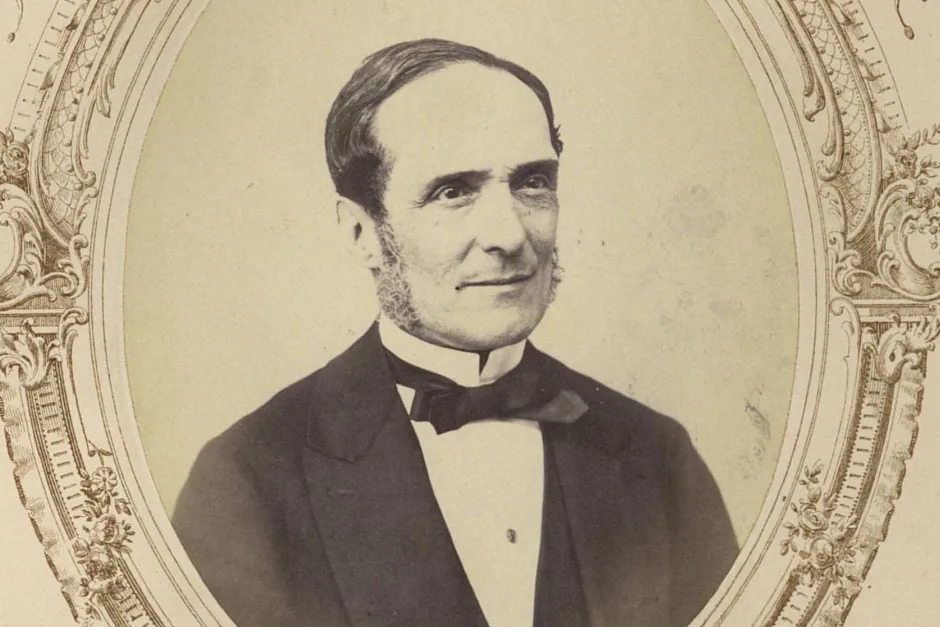
Fernando Calderón y Collantes por José Suárez, 1869